
Luxury buyers and sellers rarely begin by asking which professional has the most attractive logo, the largest advertising budget or the longest résumé.
They begin with a problem.
They may ask Google which luxury Realtor understands a particular neighborhood, which boutique brokerage has experience serving high-net-worth sellers, which custom home builder is best suited for a complex architectural project, or which developer has the strongest record in a growing luxury market.
Increasingly, the answer is being shaped before a prospect ever visits a website.
AI Overviews, AI-powered search experiences and conversational tools can now research a topic, compare options and summarize what they find. That changes the competitive question. It is no longer enough to ask:
“Does my website rank for a few important keywords?”
The more consequential question is:
“Does my entire digital footprint give search engines and prospective clients enough credible evidence to recognize, understand and recommend my business?”
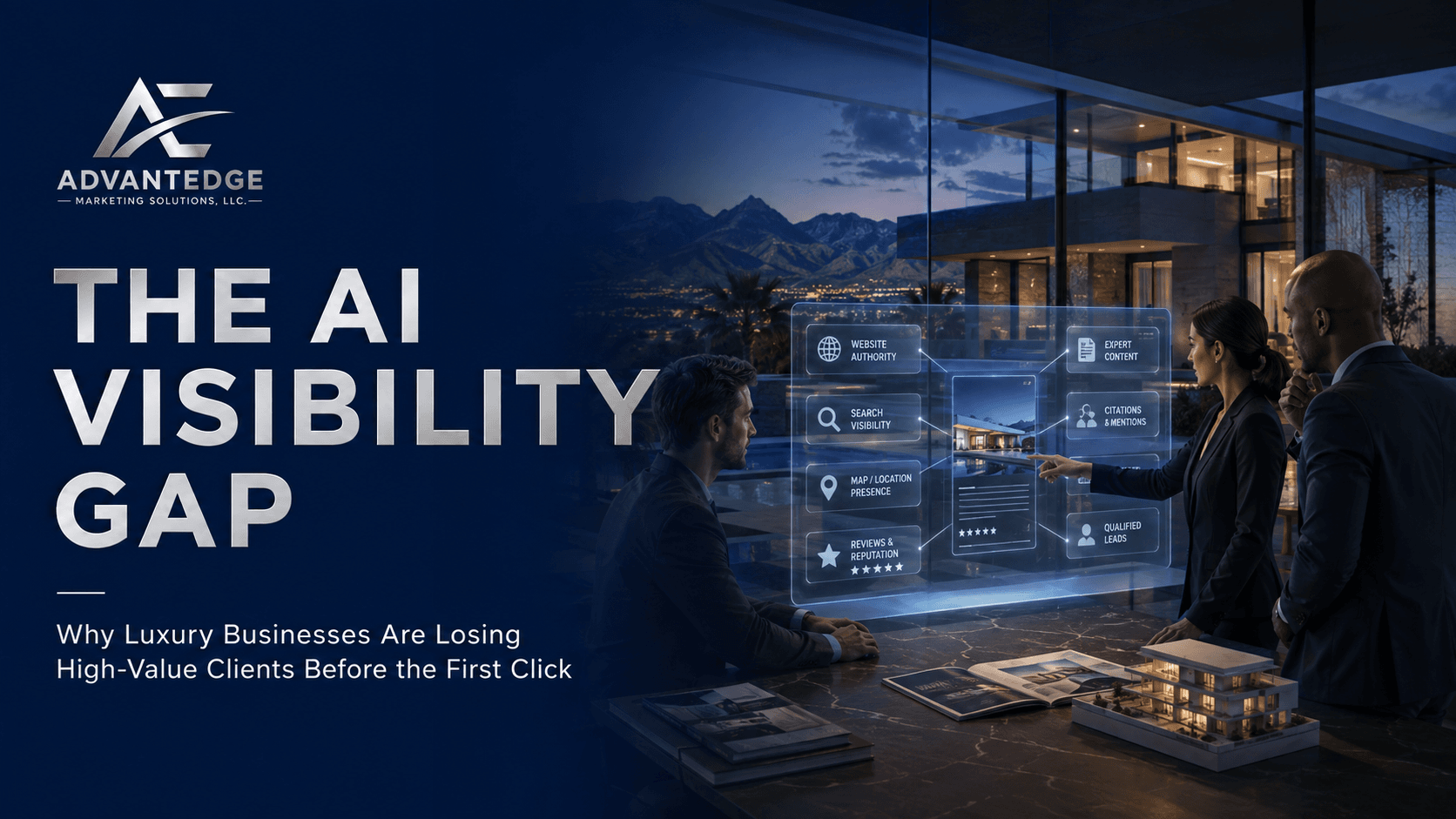
For luxury Realtors®, elite brokerages, custom home builders, developers and contractors, the space between those two questions is the AI visibility gap—and it can quietly cost a business its most valuable opportunities.
What Is the AI Visibility Gap?
The AI visibility gap is the difference between the authority a business has earned in the real world and the authority that search systems can verify online.
A luxury professional may have decades of experience, exceptional client relationships and an impressive portfolio. But if that expertise is scattered across disconnected platforms, expressed in generic language or unsupported by visible proof, search systems receive an incomplete picture.
The result is a frustrating contradiction: a highly qualified business can be overlooked while a more digitally coherent competitor becomes easier to discover and trust.
This is not simply a branding problem. It is a business-development problem.
When affluent prospects conduct research, they typically encounter a collection of signals: website pages, local listings, reviews, articles, videos, professional profiles, media mentions, project portfolios and third-party references. Together, those signals either reinforce one persuasive identity—or create doubt.
AI Search Has Not Replaced SEO. It Has Raised the Standard.
One of the most persistent misconceptions is that businesses need an entirely separate bag of tricks for generative AI search. Google’s current guidance says otherwise: established SEO best practices remain relevant because its generative AI features are rooted in core Search ranking and quality systems. Google also emphasizes useful, original content and a clear technical structure rather than content manufactured primarily to manipulate AI results. (Google Search Central)
That distinction matters.
Traditional SEO often focused heavily on matching a page to a search phrase. AI-assisted discovery can involve a broader investigation. Google describes a process called query fan-out, in which an AI system may generate multiple related searches to explore different dimensions of a person’s request. (Google Search Central)
Consider the difference:
- A conventional search might be: “luxury Realtor Summerlin.”
- A conversational search might be: “Who is the best luxury Realtor for selling a contemporary home in Summerlin, and who demonstrates strong market knowledge, premium presentation and experience reaching qualified out-of-state buyers?”
The second request contains several implied questions. A brand must demonstrate geographic relevance, specialized expertise, marketing capability, reputation and the ability to serve a particular type of client.
One optimized homepage cannot carry that entire burden.
The Seven Signals That Make a Luxury Brand Easier to Discover and Trust
1. A Clearly Defined Market Position
If your website says you offer “quality service for all your real estate needs,” you sound interchangeable with thousands of competitors.
Strong digital authority begins with specificity. Search systems and human visitors should quickly understand:
- Whom you serve
- Where you operate
- What high-value problems you solve
- What category of expertise you own
- Why your approach is distinct
A custom home builder might own the position of designing architecturally distinctive desert-modern residences for discerning Summerlin homeowners. A luxury Realtor may specialize in strategic representation for high-net-worth sellers relocating from California. An elite brokerage might be known for discreet, high-touch representation in guard-gated communities.
Specificity does not make a premium brand smaller. It makes the brand memorable, relevant and referable.
2. Expert-Led Content That Competitors Cannot Easily Imitate
Generic content is becoming a liability because it offers little proof of genuine experience.
Google’s people-first guidance encourages content that demonstrates experience, expertise, authoritativeness and trust. (Google Search Central) The strategic implication for luxury professionals is clear: publish what you know because you have done the work—not what any general-purpose content tool could assemble.
High-authority topics might include:
- What luxury sellers should correct before a pre-listing design consultation
- How land orientation affects privacy, light and long-term value in a custom-home project
- The differences between marketing an architectural estate and a conventional luxury listing
- What affluent buyers should evaluate beyond finishes and square footage
- How entitlement, design review and construction timelines influence a development decision
The most defensible content includes original observations, decision frameworks, project lessons, local context, professional commentary and useful examples.
AI can assist the production process. It should not replace the expertise that makes the content worth finding.
3. Consistent Identity Across the Digital Footprint
Your website, Google Business Profile, social channels, professional biographies and directory listings should tell the same story.
Inconsistencies create friction. A business name that varies across platforms, outdated service descriptions, conflicting contact details or a founder whose expertise is absent from the company website can weaken entity clarity.
At a minimum, align:
- Business name, address, phone number and website
- Primary service categories
- Geographic markets served
- Founder and leadership biographies
- Brand positioning and specialty descriptions
- Logo, photography and visual presentation
- Links between official profiles
Appropriate Organization and LocalBusiness structured data can also give Google explicit information about a company and its business details. Structured data is not a shortcut to rankings or AI citations, but it can help search engines interpret eligible information and search features. (Organization structured data; LocalBusiness structured data)
4. Local Prominence Beyond a Complete Profile
Claiming a Google Business Profile is a starting point—not a local visibility strategy.
Google states that local results are primarily based on relevance, distance and prominence. (Google Business Profile Help) A luxury-market brand should therefore strengthen both the accuracy of its profile and the broader evidence of its standing in the community.
That includes:
- Selecting accurate primary and secondary categories
- Completing services, business information and attributes
- Publishing high-quality project and team photography
- Earning a steady stream of authentic client reviews
- Responding to reviews with professionalism and useful context
- Building locally relevant service and market pages
- Securing legitimate mentions, associations and coverage
- Publishing content tied to the communities and decisions clients care about
The goal is not to manufacture popularity. It is to make genuine local relevance visible.
5. Proof That Reduces Perceived Risk
Luxury transactions carry high financial and emotional stakes. Prospects are not merely looking for capability; they are looking for reasons to feel safe choosing you.
Effective proof may include:
- Detailed case studies
- Curated project portfolios
- Client testimonials and verified reviews
- Professional credentials
- Awards and reputable media coverage
- Before-and-after examples
- Documented processes
- Named authors and expert biographies
- Clear explanations of standards, safeguards and communication
Avoid vague claims such as “unmatched service” unless the surrounding experience demonstrates what unmatched actually means.
Proof should answer the prospect’s silent question: “Why should I trust this firm with a decision of this magnitude?”
6. A Technically Accessible, Conversion-Ready Website
Authority cannot perform if search engines cannot reliably access the pages that contain it.
Google explains that a page must be indexed and eligible to appear in Search to participate in its generative AI features. It also recommends crawlable content and a clear technical structure. (Google Search Central)
Every luxury brand should routinely evaluate:
- Indexing and crawlability
- Mobile usability
- Page speed and visual stability
- Logical site architecture
- Descriptive page titles and headings
- Internal links between related expertise
- Image optimization and meaningful alternative text
- Structured data accuracy
- Broken links, duplicate pages and outdated redirects
- Clear calls to action and low-friction inquiry paths
Technical SEO is not glamorous. Neither is losing a qualified lead because a beautiful website is slow, confusing or invisible.
7. Measurement That Connects Visibility to Business Outcomes
Rankings alone do not reveal whether your authority strategy is creating profitable momentum.
Build a measurement framework that connects discovery to action:
- Non-branded search impressions and clicks
- Visibility for priority services and markets
- Google Business Profile interactions
- Engagement with expert content and case studies
- Qualified calls, forms and consultations
- Lead source and service-line attribution
- Conversion rate by landing page
- Branded search growth over time
- Mentions or citations in relevant AI-assisted research journeys
Google advises website owners to use Search Console to understand search performance and warns that no third-party tool has access to Google’s internal ranking or AI systems. (Google Search Central)
Measurement should inform decisions—not create the illusion of certainty. The objective is to identify which assets, topics and channels contribute to qualified demand, then strengthen them systematically.
Why Random Marketing Tactics Fail
Many businesses attempt to solve a visibility problem by doing more: more posts, more ads, more videos, more keywords and more automation.
Volume without alignment creates noise.
A high-performing digital authority strategy works as a connected system:
- Positioning defines what the brand should be known for.
- Technical SEO makes the brand’s evidence accessible.
- Content demonstrates expertise and answers consequential questions.
- Local optimization establishes geographic relevance and prominence.
- Reputation supplies independent proof.
- Conversion strategy turns attention into qualified conversations.
- Measurement identifies where the system is strong, weak or disconnected.
If one component contradicts another, the entire journey becomes less persuasive.
A Practical 30-Day AI Visibility Sprint
Luxury professionals do not need to rebuild everything at once. Begin with four focused weeks.
Week 1: Clarify
- Define your highest-value audience, service and market.
- Rewrite your core positioning in specific, client-centered language.
- Compare the story told by your website, local profile and professional biographies.
Week 2: Validate
- Confirm that priority pages are indexed.
- Review site architecture, mobile experience and conversion paths.
- Audit business information and profile consistency.
Week 3: Prove
- Build or improve one case study.
- Publish one expert article answering a high-stakes client question.
- Add meaningful author, credential, portfolio and testimonial evidence.
Week 4: Amplify
- Repurpose the expert insight into email, social and video formats.
- Link related pages so authority is not trapped in isolated content.
- Establish a simple dashboard for visibility, engagement and qualified inquiries.
This sprint will not complete a digital transformation. It will reveal whether your foundation can support one.
The Strategic Advantage Belongs to the Brand With the Clearest Evidence
In luxury markets, excellence is expected. The competitive advantage comes from making that excellence easy to recognize, verify and choose.
The businesses most likely to thrive in AI-assisted discovery will not necessarily be those publishing the most content. They will be the ones building the clearest relationship between expertise, local relevance, reputation, proof and client value.
Your real-world reputation should not remain a well-kept secret online.
Discover What Is Limiting Your Digital Authority
The AdvantEdge Digital Authority Assessment is designed to diagnose the gaps between how your business wants to be perceived and what prospects, Google and AI-powered search systems can actually verify.
We examine the connected factors that influence visibility and trust—including brand positioning, website performance, SEO, AI search readiness, local presence, content authority, reputation signals and conversion pathways—then identify the priorities most likely to improve competitive positioning and qualified lead generation.
For a limited time, the 2027 Pre-Planning Special is $997—a $2,500 value—for the first 20 applicants or through September 30, 2026, whichever comes first. Your $997 investment will be applied toward the cost of an approved implementation plan.
Do not enter the 2027 planning season guessing which marketing tactics matter most. Begin with a diagnosis.
Request Your Digital Authority Assessment
AdvantEdge Marketing Solutions, LLC.
702-986-9313
www.AdvantEdgeMarketingSolutions.com
Frequently Asked Questions
What is AI search optimization for luxury real estate?
AI search optimization is the process of making a luxury real estate brand’s expertise, services, locations and credibility easy for search and AI systems to access, understand and substantiate. It combines sound SEO, authoritative content, local optimization, consistent business information, reputation signals and a technically accessible website.
Is AI search optimization different from traditional SEO?
AI-assisted search creates broader, more conversational discovery journeys, but the foundation remains strong SEO. Google states that its established SEO best practices continue to apply to AI Overviews and AI Mode. The strategic evolution is to optimize the whole authority system—not merely a page for one keyword.
Do luxury Realtors and builders need an llms.txt file to appear in Google’s AI results?
No. Google’s current guidance says it does not use llms.txt files for Google Search or its generative AI features. A crawlable, technically sound website with valuable original content is a higher priority. Other services may develop different requirements, so implementation decisions should be based on verified platform guidance rather than hype.
How can a Google Business Profile support AI visibility?
A complete and accurate profile helps establish business details and local relevance. Google notes that Business Profiles can help local business information appear in AI responses and other Search results. Profile optimization should be supported by an authoritative website, authentic reviews, locally relevant content and consistent information across the web.
How long does it take to improve digital authority?
Some corrections—such as inaccurate business information, weak calls to action or missing proof—can be addressed quickly. Meaningful growth in search visibility, reputation and qualified demand typically requires sustained work. Timing depends on competition, the condition of the current digital footprint and the consistency of implementation.
What does a Digital Authority Assessment evaluate?
The AdvantEdge Digital Authority Assessment evaluates the connected factors that shape how a business is discovered and trusted online, including positioning, website performance, SEO, AI search readiness, content, local presence, reputation and conversion pathways. Its purpose is to replace guesswork with prioritized, evidence-based action.


