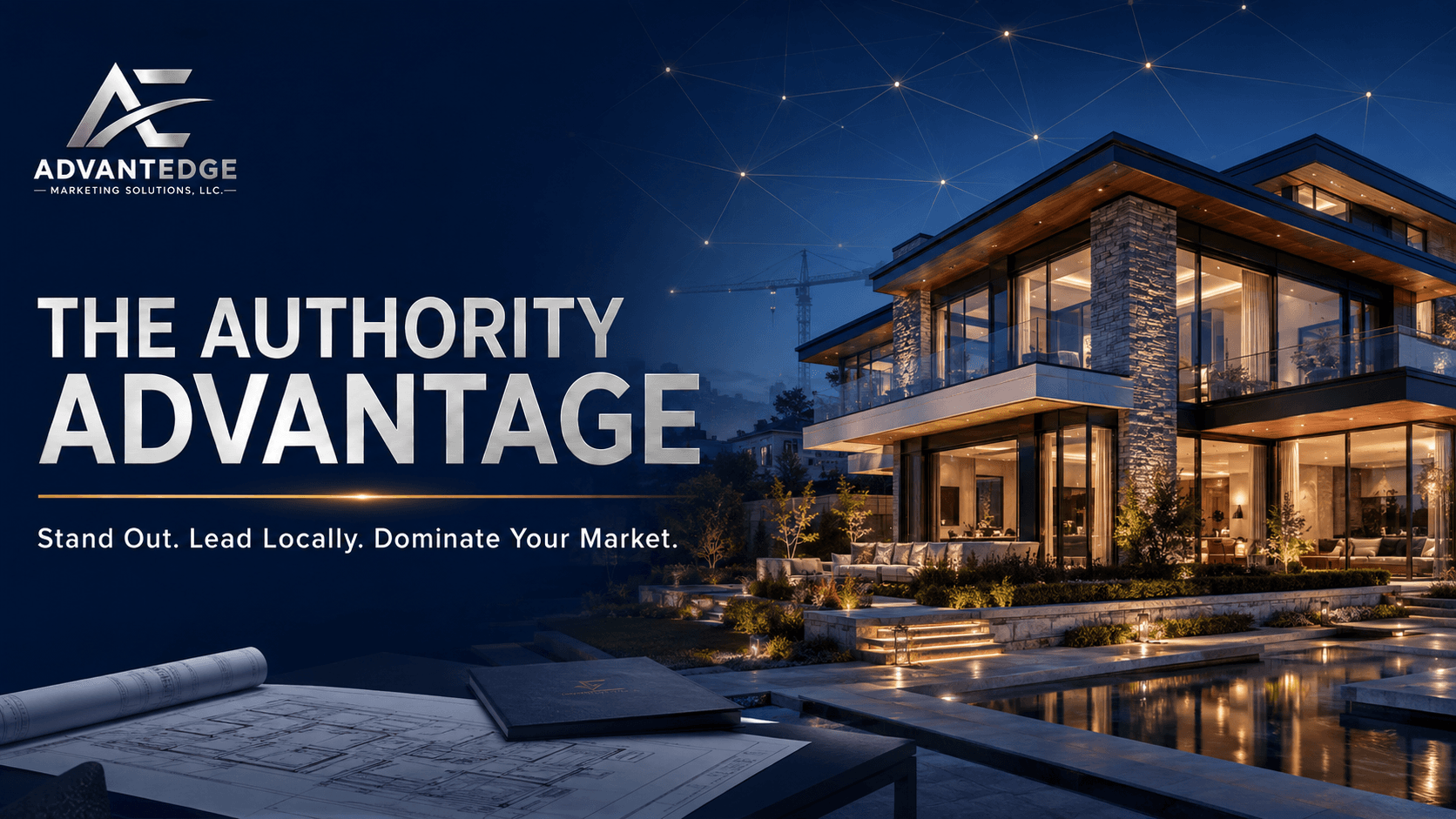
In a crowded luxury market, excellence is not enough.
You can be the most knowledgeable Realtor®, the most accomplished brokerage, the most meticulous custom home builder, or the most reliable developer or contractor in your region—and still lose opportunities to a competitor whose digital presence makes that expertise easier to find, understand, and trust.
That is the modern visibility gap: the distance between the reputation you have earned offline and the authority prospective clients perceive online.
Affluent clients, investors, landowners, and referral partners rarely make high-value decisions on a single impression. They search. They compare. They review websites, project portfolios, local results, testimonials, leadership profiles, and third-party mentions. Increasingly, they also use AI-powered tools to narrow their options and answer questions before contacting a professional.
If your digital presence does not validate your real-world reputation, your best prospects may never discover why you are the better choice.
The solution is not to become louder. It is to become more authoritative.
The Real Competitive Problem Is Not Abundance. It Is Sameness.
Most local markets are filled with polished claims:
- “Unparalleled service.”
- “Exceptional craftsmanship.”
- “Local expertise.”
- “Luxury redefined.”
- “Committed to excellence.”
These phrases may be true, but they are not differentiators. When every competitor uses similar language, similar photography, and similar promises, prospective clients are left to compare what they can verify.
That usually means visible proof: market knowledge, relevant results, recognized expertise, a distinctive point of view, a strong local footprint, and a seamless path from research to conversation.
Luxury buyers do not merely purchase a property or project. They purchase judgment, discretion, execution, access, and confidence. Your marketing must make those intangible advantages tangible.
This is why digital authority matters.
What Digital Authority Actually Means
Digital authority is the combined strength of your brand positioning, online visibility, expertise, credibility signals, and user experience. It answers five questions every high-value prospect is asking, whether consciously or not:
- Are you relevant to my specific need?
- Do you understand this market at an expert level?
- Can you prove you have delivered comparable results?
- Do credible people and platforms validate you?
- Is taking the next step clear, professional, and low-friction?
A beautiful website can support authority, but design alone does not create it. Authority is built when your positioning, content, search presence, reputation, proof, and conversion strategy reinforce one another.
Think of it as a connected system:
Positioning creates relevance. Visibility earns attention. Proof builds trust. Conversion turns trust into opportunity.
If one part is weak, the entire system underperforms.
Seven Ways to Build a Local Authority Advantage
1. Own a Defensible Position—not a Generic Category
“Luxury Realtor” or “custom home builder” describes what you are. It does not explain why a discerning client should choose you.
A defensible position combines the right client, the right problem, the right geography, and a meaningful advantage. For example:
- An advisor specializing in discreet representation for high-net-worth sellers in a defined community
- A brokerage known for relocation intelligence and off-market access in a specific luxury corridor
- A builder recognized for architect-led contemporary estates on complex hillside sites
- A developer with proven expertise in entitlements and boutique infill opportunities
- A contractor specializing in occupied luxury-home renovations with rigorous site protection and communication
Strong positioning requires focus. The goal is not to exclude every other opportunity; it is to become the obvious choice for the opportunities you value most.
Your homepage, service pages, biographies, portfolio, Google Business Profile, and social presence should all communicate the same strategic position. If each channel tells a different story, the market cannot form a clear memory of your brand.
2. Build a Website Around Decisions, Not a Digital Brochure
Luxury websites often look impressive but make prospects do too much interpretive work. Large photographs, dramatic video, and elegant typography may create atmosphere, yet atmosphere without clarity can suppress inquiries.
Within seconds, a visitor should understand:
- Who you serve
- Where you operate
- What you do exceptionally well
- What evidence supports your claims
- What the next step should be
Create dedicated pages for high-value services, property or project types, and priority locations. A brokerage serving multiple luxury communities should not rely on one general “areas served” page. A builder with expertise in new estates, major renovations, and design-build delivery should explain each service separately.
Each page should help a prospect make a decision. Include relevant proof, explain your process, answer meaningful questions, and present a clear call to action. Strong architecture also helps search engines and AI systems understand the relationship between your expertise, services, and geographic market.
3. Win Locally with Depth, Not Keyword Repetition
Local visibility is not achieved by inserting a city name into a page twenty times. It is earned by demonstrating genuine geographic relevance.
Build locally useful resources such as:
- Luxury market reports with original interpretation
- Neighborhood and community guides
- Design-review or architectural-guideline explainers
- Building, permitting, zoning, or entitlement insights
- Land-acquisition and site-feasibility guidance
- Renovation planning considerations for local housing stock
- Case studies tied to recognizable property or project challenges
This approach gives prospective clients a reason to trust you while providing search platforms with substantive evidence of local expertise.
Your Google Business Profile should reinforce that relevance. Maintain accurate categories and contact information, publish current photography, describe services precisely, answer common questions, and earn a steady flow of authentic reviews. Respond to those reviews thoughtfully; a generic “Thanks!” wastes an opportunity to demonstrate care and context.
For businesses serving several locations, create useful location pages only when you can give each one distinct, meaningful content. Thin, duplicated pages may create volume, but they do not create authority.
4. Turn Completed Work into Evidence
High-end firms frequently underuse their strongest marketing asset: the work they have already done.
A gallery shows taste. A case study shows judgment.
Instead of presenting only finished photography, explain:
- The client’s objective
- The market, site, design, schedule, or construction challenge
- The strategic decision your team made
- How the process unfolded
- The measurable or meaningful outcome
- What a similar client should learn from the project
For Realtors and brokerages, that might mean explaining how positioning, preparation, pricing, or network strategy affected a result—without violating confidentiality. For builders and contractors, it might mean documenting how the team solved drainage, access, structural, material, sequencing, or occupied-site challenges. For developers, it might mean showing how research, entitlement strategy, design, and stakeholder coordination shaped an opportunity.
The strongest proof is specific. Replace unsupported superlatives with facts, processes, decisions, and outcomes.
Where confidentiality matters, anonymize the client and sensitive details while preserving the strategic lesson. Discretion itself can be part of the evidence.
5. Publish Expertise That Helps Sophisticated Clients Decide
Many firms assume content marketing means constantly posting. It does not. Authority content is not measured by frequency alone; it is measured by usefulness, originality, and relevance to a valuable decision.
Start with the questions your best prospects ask before they hire you:
- How should a luxury property be prepared and positioned before launch?
- What makes one custom-builder proposal meaningfully different from another?
- When should an owner involve a contractor during design?
- How do entitlement risks affect land value and development timing?
- Which renovation decisions protect long-term resale value?
- How should an out-of-market buyer evaluate neighborhoods, privacy, access, and amenities?
Answer these questions with genuine expertise. Explain tradeoffs. Share a point of view. Identify risks. Clarify what a less-experienced client may overlook.
One substantial article can become a market email, a short video, several social posts, a sales follow-up, and a section of an FAQ page. That is a content system. It is more valuable than isolated posts created merely to keep a feed active.
This depth also supports visibility in both traditional and AI-assisted search. Clear explanations, strong subject-matter coverage, consistent business information, and well-structured pages make it easier for digital platforms to understand what your firm is qualified to address. No firm can guarantee inclusion in AI-generated answers, but authoritative content makes your expertise more legible and useful across discovery channels.
6. Engineer Trust Across the Entire Digital Footprint
Prospects do not evaluate your website in isolation. They assemble an impression from many signals:
- Search results
- Reviews
- Media coverage
- Professional profiles
- Awards and memberships
- Social content
- Partner mentions
- Directory listings
- Project photography
- Leadership visibility
Inconsistency creates doubt. An exceptional website paired with outdated profiles, unanswered reviews, incomplete biographies, or conflicting contact information weakens credibility.
Conduct a digital-footprint audit. Search your firm, leadership, core services, and priority locations. Note what appears, what is missing, and what a prospect could reasonably conclude.
Then strengthen legitimate third-party validation. Pursue relevant editorial opportunities, association profiles, local partnerships, expert commentary, community involvement, design or business awards, and links from trusted collaborators. Avoid shortcuts that manufacture the appearance of credibility. In luxury markets, trust is too valuable to build on tactics that cannot withstand scrutiny.
7. Make Conversion Feel Like the Beginning of a Premium Experience
Visibility without conversion creates traffic, not growth.
Every priority page should offer a logical next step aligned with the visitor’s stage of decision-making. “Contact us” is functional, but it is rarely compelling. Consider more relevant invitations:
- Request a confidential property-positioning consultation
- Discuss your homesite and project goals
- Schedule a development feasibility conversation
- Request a preconstruction planning review
- Explore your local digital authority opportunities
Keep forms concise. Set expectations for what happens after submission. Make phone numbers clickable on mobile. Confirm inquiries promptly. Ensure lead notifications reach a responsible person.
For premium brands, the conversion process is part of the brand. A confusing form, slow response, or generic follow-up can undo the confidence your marketing worked to create.
How the Strategy Changes by Business Type
The authority framework is consistent, but the proof should reflect the buyer’s risk.
Luxury Realtors and Elite Brokerages
Demonstrate market interpretation, negotiation judgment, discretion, network quality, and an ability to position extraordinary properties. Go beyond listing feeds. Publish original local insight, detailed service standards, strategic success stories, and neighborhood expertise that a portal cannot replicate.
Custom Home Builders
Show how your process reduces uncertainty. Explain preconstruction, budgeting, selections, schedule management, quality control, communication, and warranty support. Pair beautiful portfolios with evidence of how your team protects the client’s time, investment, and design intent.
Developers
Build authority around opportunity recognition and risk management. Highlight market intelligence, site selection, entitlements, design strategy, stakeholder coordination, execution, and completed outcomes. Your digital presence should speak credibly to landowners, capital partners, buyers, tenants, and civic stakeholders where appropriate.
Luxury Contractors and Specialty Trades
Compete on professionalism as well as craft. Document technical expertise, project controls, site protection, collaboration with architects and designers, communication standards, and the ability to solve difficult conditions. The more costly the mistake, the more important visible process becomes.
Measure Authority by Business Impact
Rankings matter, but they are not the final objective. A useful measurement framework connects visibility to opportunity.
Track indicators across four stages:
Visibility: qualified impressions, local search presence, non-branded discovery, priority-page traffic, and visibility for relevant questions.
Engagement: time with key content, portfolio and case-study views, return visits, email subscriptions, and video engagement.
Trust: review quality and velocity, branded searches, direct traffic, referral traffic, media mentions, and links from credible sources.
Conversion: qualified inquiries, booked consultations, proposal opportunities, lead-to-client rate, sales cycle, project value, and source-attributed revenue.
The goal is not maximum traffic. A thousand poorly matched visitors are less valuable than ten qualified prospects with the need, means, geography, and intent to hire you.
Review performance monthly, but judge strategic content over a longer horizon. Authority compounds as valuable pages gain visibility, links, engagement, and recognition.
A Practical 90-Day Authority Roadmap
Days 1–30: Diagnose and Prioritize
- Clarify your highest-value audiences, services, and markets.
- Review competitor positioning and search visibility.
- Audit website performance, technical SEO, conversion paths, profiles, reviews, and analytics.
- Identify the largest gap between your offline reputation and online presence.
- Select three to five high-impact priorities rather than attempting everything at once.
Days 31–60: Strengthen the Foundation
- Refine positioning and core messaging.
- Improve priority service and location pages.
- Resolve critical technical, mobile, speed, indexing, analytics, and conversion issues.
- Upgrade biographies, proof, calls to action, and Google Business Profile content.
- Establish a consistent system for requesting and responding to reviews.
Days 61–90: Publish and Amplify Authority
- Release one flagship local authority resource.
- Publish one or two decision-focused case studies.
- Repurpose those assets for email, social, video, and sales conversations.
- Build legitimate partner, association, media, and community visibility.
- Measure qualified engagement and inquiries, then refine the next 90-day plan.
The sequence matters. Promotion amplifies whatever already exists. Strengthen the message, experience, and proof before increasing traffic.
The Question Every Luxury Brand Should Ask
If an ideal client compared your digital presence with your three strongest competitors today, would the evidence make you the clear choice?
If the answer is uncertain, more random marketing activity is unlikely to solve the problem. You need to know where authority is being won, where it is being lost, and which improvements will have the greatest commercial impact.
Discover Your Strongest Path to Local Market Authority
The AdvantEdge Digital Authority Assessment™ is a comprehensive, executive-level evaluation designed to uncover the gaps, competitive opportunities, and highest-priority actions affecting your growth.
Your assessment evaluates:
- Brand authority
- Website performance
- Technical SEO
- AI search readiness
- Google SEO opportunities
- Competitor positioning and visibility
- Lead generation and conversion strategy
- A customized 90-day growth roadmap
For a limited time, the assessment—regularly valued at $2,500+—is available for a $997 launch investment. If you move forward with an AdvantEdge implementation package within 30 days, the full $997 is credited toward your first month of service.
This is not another generic automated report. It is a strategic view of how your business is seen, where competitors may be gaining ground, and what you can do next to build meaningful authority in your local market.
Explore the AdvantEdge Digital Authority Assessment™
Or call 702-986-9313 to start the conversation.
Be Seen. Be Chosen. Be the Authority.
Frequently Asked Questions
What is digital authority in luxury real estate and construction?
Digital authority is the degree to which your online presence demonstrates relevance, expertise, credibility, and trust. It is built through clear positioning, useful content, strong local visibility, client and project proof, third-party validation, technical quality, and a professional conversion experience.
How can a luxury Realtor stand out in a crowded market?
A luxury Realtor can stand out by owning a specific position, publishing original local market insight, demonstrating strategic judgment through case studies, strengthening reviews and third-party credibility, and building service and neighborhood content that is more useful than a generic listing portal.
What should a custom home builder include in a digital marketing strategy?
A custom home builder should combine a high-quality portfolio with detailed process information, decision-focused educational content, project case studies, local search optimization, authentic reviews, technical website performance, and clear consultation pathways. Prospects need evidence of both design quality and execution discipline.
Does AI search optimization replace traditional SEO?
No. AI search readiness and traditional SEO overlap in important ways: clear website structure, relevant expertise, accurate business information, crawlable content, reputable third-party mentions, and genuinely useful answers. The goal is to strengthen the underlying authority and accessibility of your information across discovery platforms.
How long does it take to build local digital authority?
Important website and conversion improvements can produce near-term gains, while search visibility, reputation, and recognized authority typically compound over time. A focused 90-day roadmap can establish the foundation, but sustainable market leadership requires consistent execution, measurement, and refinement.
What is included in the AdvantEdge Digital Authority Assessment™?
The assessment reviews brand authority, website performance, technical SEO, AI search readiness, Google SEO opportunities, competitors, lead generation, and conversion strategy. It concludes with a customized 90-day growth roadmap organized around the most important opportunities.